Period Sources of Printed Music for Cittern, Bandora, & OrpharionLast updated Sunday, April 02, 2023. |
The following is a table of period printed (as opposed to manuscript) sources of music for cittern, bandora, and orpharion. Clicking on a title in blue will display the contents for that book. I hope eventually to have links to the contents for all extant prints. If there are any other sources you know of that have been missed, or if you have a correction, please contact me and I will be more than happy to include them.
N.B. A title in brackets denotes a lost source.
Sources for Cittern:
| Title | Composer / Publisher | Year of Publication | Place of Publication / Publisher | Type of Instrument | Type of Tablature | Notes |
|---|---|---|---|---|---|---|
| [Cythare Germanice Tabulature] | Schlumberger, J. | 1525/1532 | Mainz? | |||
| [Briefve et facile instruction] | Le Roy, Adrian | 1551 | Paris: ? | |||
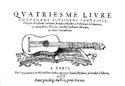 Quatriesme livre contenant plusieurs fantasies . . . |
Morlaye, Guillaume | 1552 | Paris: Michel Fezandat | 4-course diatonic cittern | French tab | French tuning. Book of guitar pieces; contains 9 cittern works. Early (strictly?) diatonic cittern, missing 1st fret. |
| [Carmina Quae Cythara Pulsantur] | Vreedman, Sebastian | 1563 | Louvain: Pierre Phalèse | |||
| Second Livre de Cistre | Le Roy, Adrian | 1564 | Paris: Adrian Le Roy and Robert Ballard | 4-course diatonic cittern | French tab | French tuning. |
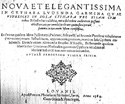 Nova et Elegantissima in Cythara |
Viaera, Frederico | 1564 | Louvain: Pierre Phalèse | 4-course diatonic cittern | French tab | French tuning. Includes cittern pieces to accompany Pacoloni lute trios followed by solo cittern works. |
| Breve et facile instruction pour apprendre la tablature | Le Roy, Adrian and Robert Ballard | 1565 | Paris: Adrian Le Roy and Robert Ballard | 4-course diatonic cittern | French tab | French tuning. Modern edition and translation available as free PDF. |
| [The Breffe and Playne Instruction to Lerne to Play on the Gyttron and Also the Cetterne] | Rowbotham, James | 1568 | London: James Rowbotham | Reprint of Le Roy and Ballard 1565? | ||
 Nova Longeque Elgantissima Cithara |
Vreedman, Sebastian | 1568 | Louvain: Pierre Phalèse | 4-course diatonic cittern | French tab | French tuning. |
| [Carmina Italica, Gallica & Germanica Ludenda Cythara] | Kargel, Sixt | 1569 | ||||
| [Renovata Cythara] | Kargel, Sixt | 1569 | ||||
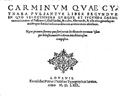 Carminum quae cythara pulsantur liber secundus |
Vreedman, Sebastian | 1569 | Louvain: Pierre Phalèse | 4-course diatonic cittern | French tab | French tuning. |
| [Livre de Tabulature de Cistre] | Gorlier, Simon | 156? | Lyon: Simon Gorlier | |||
| [Troisième Livre de Cistre] | Le Roy, Adrian | 156? or 1570? | While Brown's Instrumental Music lists this volume as 156?, Grijp notes in "Fret Patterns of the Cittern" that Brown's source lists no date for theTroisième Livre and one of Mersenne's texts lists a book by Le Roy with a specific date of 1570. | |||
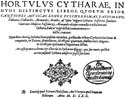 Hortulus Cytharae |
Phalèse, Pierre, and Jean Bellère | 1570 | Louvain: Pierre Phalèse and Jean Bellère | 4-course diatonic & chromatic citterns | French tab | Part I contains works for 4-course diatonic, French tuning; Part II contains works for 4-course chromatic, Italian tuning |
 Il Primo Libro di Tabolatura di Citthara |
Virchi, Paolo | 1574 | Venice: Girolamo Scotto | 6-course & 7-course chromatic citterns | Italian tab | Italian tuning. Includes some songs. |
| [Jardinet de Cistre] | 1575 | Paris: ? | ||||
| [Renovata Cythara] | Kargel, Sixt | 1575 | ||||
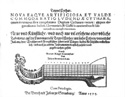 Toppel Cythar |
Kargel, Sixt, and Johan Dominico Lais | 1575 | Strassburg: Bernhard Jobin | 6-course chromatic cittern | Italian tab | |
| [Hortulus Cytharae] | Phalèse, Pierre | 1575 | Louvain: Pierre Phalèse | |||
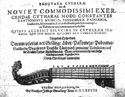 Renovata Cythara |
Kargel, Sixt | 1578 | Strassburg: Bernhard Jobin | 4-course diatonic cittern | Italian tab, inverted | French tuning. |
| Toppel Cythar | Kargel, Sixt, and Johan Dominico Lais | 1578 | Strassburg: Bernhard Jobin | 6-course chromatic cittern | Italian tab | |
| Renovata Cythara | Kargel, Sixt | 1580 | Strassburg: Bernhard Jobin | 4-course diatonic cittern | Italian tab, inverted | French tuning. |
| [Anleitung die Zither zu Spielen] | Brambilla, Ambrosius | 1582 | ||||
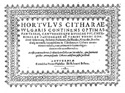 Hortulus Citharae |
Phalèse, Pierre, and Jean Bellère | 1582 | Antwerp: Pierre Phalèse and Jean Bellère | 4-course diatonic cittern | French tab | |
| [Le Jardinet du Cistre Vulgaire] | Bellère, Jean | 1592 | Anvers: Jean Bellère | |||
| [A New Booke of Citterne Lessons] | Barley, William | 1593 | London? | |||
| [A Moste Perfect and True Instruction] | Danter, J. | 1593? | London: ? | |||
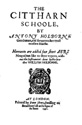 The Cittharn Schoole |
Holborne, Anthony | 1597 | London: Peter Short | 4-course chromatic cittern | French tab | Italian tuning. Works for cittern solo, cittern with voice, and cittern with bass. |
 The Psalmes of David in Meter |
Allison, Richard | 1599 | London: William Barley | 4-course chromatic cittern | French tab | Italian tuning. Consort songs set for voices, lute or orpharion and cittern. (Bandora is also specified as an option on the title page, but no bandora tablature is included.) |
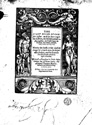 The First Booke of Consort Lessons |
Morley, Thomas | 1599 | London: William Barley | 4-course chromatic cittern | French tab. | Italian tuning. Works for "English Consort" (2 viols, lute, bandora, flute, and cittern). Of the two cittern partbooks, only the 1599 edition survives. |
| [Niew Chyterboek] | Sweelinck, J.P. | 1602 | Amsterdam? | |||
| [Primo Libro D'Intavolatura di Citara?]? | Vincenti, G. ? | pre-1602? | Venetia: Giacomo Vincenti? | 6-course? diatonic? | Italian tab.? | While not listed by any other source, Vincenti's Secondo Libro D'Intavolatura di Citara indicates that there was an earlier, first book. That such a book is for a 6-course diatonically fretted cittern in Italian tablature is purely conjecture based upon the Secondo Libro. |
 Secondo Libro D'Intavolatura di Citara |
Vincenti, G. | 1602 | Venetia: Giacomo Vincenti | 6-course diatonic* cittern | Italian tab. | * Tablature is for a "strictly" diatonic instrument (i.e. no partial frets in chromatic positions), but uses asterisks to indicate
chromatic notes between the diatonic frets. The tablature system appears to be an attempt to fit later music to a more archaic(?) instrument. Does the fact that this is a "secondo libro" indicate that there had been a previous book for cittern by Vincenti? |
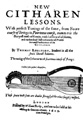 New Citharen Lessons |
Robinson, Thomas | 1609 | London: William Barley | 4-course chromatic & 14-course chromatic citterns | French tab | Italian tuning. Contains works for cittern, 2 citterns in unison, voice and cittern, cittern and bass, and 6 works for 14-course arch-cittern. |
| Consort Lessons | Rosseter, Philip | 1609 | London: Thomas Este | 4-course chromatic cittern | French tab | Italian tuning. Works for "English Consort" (2 viols, lute, bandora, flute, and cittern). |
| [The First Booke of Consort Lessons] | Morley, Thomas | 1611 | London | 4-course chromatic cittern | French tab | Italian tuning; works for "English Consort" (2 viols, lute, bandora, flute, and cittern). Second edition of 1599 volume. Of the two cittern partbooks, only the 1599 edition survives. Based on the other surviving partbooks from 1611, the cittern 1611 edition contained two additional pieces. |
| [Der Violen-Cythaer mit vyf Snaaren, en niewe Sorte melodieuse inventie, twe Naturen hebbende, vier Parthyen spelende, licht de leeren, half Violens half Cyther...] | Vreedman, Michael | 1612 | Arnheim: ? | violin-cittern? | Michael Vreedman was the son of Sebastian Vreedman and was a maker of violins and citterns in Utrecht from 1583 on. He supposedly invented a violin-cittern, for which this method (in tablature) was published. Vander Straeten, La musique au Pays-Bas VIII, pp.419ff prints a 17th-century list of musicalia which contains mention of "Obras de Cythara, Miguel Vreedman." (Waldbauer) Whether or not these "obras" were also for the violin-cittern or for regular cittern is unknown. A copy of Der Violen Cyther also shows up in an inventory of Frisian clerk Pibo Gaulthieri of Leeuwarden in 1618, along with two six-course citterns built by Vreedman. (Visscher) |
|
 The Teares or Lamentacions of a Sorrowfull Soule |
Leighton, Sir William | 1614 | London: William Stansby | 4-course chromatic cittern | French tab | The first half of this work contains religious consort songs set for what appears to be an "English Consort" (2 viols, lute, bandora, flute, and cittern) plus voices. Note: the 1613 edition does not contain music. |
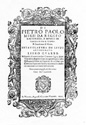 Intavolatura di Liuto Attiorbato, Libro Quarto |
Melii, Pietro Paulo | 1616 | Venetia: Giacomo Vincenti | 9c. ("Citara Tiorbata") chromatic cittern | Italian tab | Italian tuning, 9(+?) courses, "Cordatura del Signor Paolo Virgo," possibly F or A-?-G-d-f-b-g-d'-e'. (Segerman erroneously calls for A-B-c-d-f-b-g-d'-e'.) Primarily works for lute; however, the volume contains a Ballet for 9c. cittern, 3 lutes, violin, bass viol, flute, harp, and clavicembalo. |
| [Der Cytharen Lusthoff] | pre-1618 | A copy of this book is listed in the inventory of Frisian clerk Pibo Gaulthieri of Leeuwarden in 1618. (Visscher) | ||||
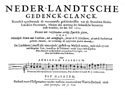 Neder-Landtsche Gedenck-Clanck |
Valerius, Adrian | 1626 | Haerlem | 4-course diatonic cittern | French tab | French tuning. Works for voice, lute and cittern. |
| [A Booke of New Lessons for the Citharen]? | Playford, John | [var. editions, 1650 ... 1658]* | * See Ward, pp. 83-93 for a detailed explantion of Playford's publications for cittern | |||
 A Booke of New Lessons for the Cithern & Gittern |
Playford, John | 1652 | London: T.H. | 4-course chromatic cittern | French tab | Italian tuning. |
| [Cithren and Gittern Lessons] | Playford, John | 1659 | London | |||
| [Musicks Solace on the Cithren and Gittern]? | Playford, John | [var. editions, 1662 ... 1696]* | * See Ward, pp. 83-93 for a detailed explantion of Playford's publications for cittern. | |||
 Musick's Delight on the Cithren |
Playford, John | 1666 | London: W.G. | 4-course chromatic cittern | French tab | Italian tuning. |
| [Treasury of Musick for Cithern, Therobo-Lute and Viol]? | * See Ward, p.93 | |||||
Sources for Bandora:
| Title | Composer / Publisher | Year of Publication | Place of Publication / Publisher | Type of Instrument | Type of Tablature | Notes |
|---|---|---|---|---|---|---|
| A banquet of daintie conceits | Munday, Anthony | 1588 | London: I. C[harlewood] | [bandora] | Title lists that the volume contains pieces to be sung "either to the lute, bandora, virginalles, or anie other instrument". No bandora tablature included. |
|
| A new booke of tabliture for the bandora | Barley, William | 1596 | London | 7-course bandora | French tab. | Both for solo bandora and bandora with voice. |
The Psalmes of David in Meter |
Allison, Richard | 1599 | London: William Barley | [bandora] | Italian tuning. Consort songs set for voices, lute or orpharion and cittern. (Bandora is also specified as an option on the title page, but no bandora tablature is included.) | |
The First Booke of Consort Lessons |
Morley, Thomas | 1599 | London: William Barley | 6-course bandora | French tab. | Italian tuning. Works for "English Consort" (2 viols, lute, bandora, flute, and cittern). Of the two cittern partbooks, only the 1599 edition survives. |
 The Schoole of Musicke |
Robinson, Thomas | 1603 | London: Thomas Este | [bandora] | Though bandora is mentioned on the title page, no bandora tablature is included.specifically for orpharion. | |
| Consort Lessons | Rosseter, Philip | 1609 | London: Thomas Este | 6-course bandora | French tab | Italian tuning. Works for "English Consort" (2 viols, lute, bandora, flute, and cittern). |
| [The First Booke of Consort Lessons] | Morley, Thomas | 1611 | London | 6-course bandora | French tab | Italian tuning; works for "English Consort" (2 viols, lute, bandora, flute, and cittern). Second edition of 1599 volume. Of the two cittern partbooks, only the 1599 edition survives. Based on the other surviving partbooks from 1611, the cittern 1611 edition contained two additional pieces. |
The Teares or Lamentacions of a Sorrowfull Soule |
Leighton, Sir William | 1614 | London: William Stansby | 6-course(?) bandora | French tab | The first half of this work contains religious consort songs set for what appears to be an "English Consort" (2 viols, lute, bandora, flute, and cittern) plus voices. Note: the 1613 edition does not contain music. |
| Mottects or Graue chamber musique | Peerson, Martin | 1630 | London: William Stansby | [bandora] | The full title states that the music is "all fit for voyces and vials, with an organ part; which for want of organs, may be performed on virginals, base-lute, bandora, or Irish harpe." No bandora tablature included. |
Sources for Orpharion:
| Title | Composer / Publisher | Year of Publication | Place of Publication / Publisher | Type of Instrument | Type of Tablature | Notes |
|---|---|---|---|---|---|---|
| A new booke of tabliture for the orpharion | Barley, William | 1596 | London | 7-course orpharion | French tab. | |
The Psalmes of David in Meter |
Allison, Richard | 1599 | London: William Barley | [orpharion] | French tab. | Italian tuning. Consort songs set for voices, lute or orpharion and cittern. (Bandora is also specified as an option on the title page, but no bandora tablature is included.) |
| The First Booke of Songes or Ayres | Dowland, John | 1600 | London: Peter Short | [orpharion] | French tab | Orpharion is mentioned as a possibility on the title page, but no pieces are listed as specifically for orpharion. |
| The Second Booke of Songes or Ayres | Dowland, John | 1600 | London: Thomas Este | [orpharion] | French tab | Orpharion is mentioned as a possibility on the title page, but no pieces are listed as specifically for orpharion. |
| A Booke of Ayres | Campion, Thomas and Philip Rosseter | 1601 | London: Thomas Este | [8-course orpharion] | French tab | Orpharion is mentioned as a possibility on the title page, but no pieces are listed as specifically for orpharion. |
| The First Booke of Songes or Ayres ... Newly Corrected. | Dowland, John | 1603 | London: E. Short | [orpharion] | French tab | Orpharion is mentioned as a possibility on the title page, but no pieces are listed as specifically for orpharion. |
| The Third and Last Booke of Songs or Aires | Dowland, John | 1603 | London: Peter Short | [orpharion] | French tab | Orpharion is mentioned as a possibility on the title page, but no pieces are listed as specifically for orpharion. |
The Schoole of Musicke |
Robinson, Thomas | 1603 | London: Thomas Este | [orpharion] | French tab | Orpharion is mentioned as a possibility on the title page, but no pieces are listed as specifically for orpharion. |
| The First Booke of Songs or Ayres of 4. Parts | Pilkington, Francis | 1605 | London: Thomas Este | [7-course orpharion] | French tab | Orpharion is mentioned as a possibility on the title page, but no pieces are listed as specifically for orpharion. |
| A Booke of Ayres with a Triplicitie of Musicke | Bartlet, John | 1606 | London: John Windet | [orpharion] | French tab | Orpharion is mentioned as a possibility on the title page, but no pieces are listed as specifically for orpharion. |
| The First Booke of Songes or Ayres ... Newly Corrected and Amended. | Dowland, John | 1606 | London: Humfrey Lownes | [orpharion] | French tab | Orpharion is mentioned as a possibility on the title page, but no pieces are listed as specifically for orpharion. |
| Musicke of Sundrie Kindes | Ford, Thomas. | 1607 | London: John Browne | [6-, 7-, and 8-course orpharion] | French tab | Orpharion is mentioned as a possibility on the title page, but no pieces are listed as specifically for orpharion. |
| Captain Humes Poeticall Musicke | Hume, Tobias | 1607 | London: John Windet | [two orpharion + bass viol] | French tab | Orpharion is mentioned as a possibility on the title page, but no pieces are listed as specifically for orpharion. |
| The First Booke of Songes or Ayres ... Newly Corrected and Amended. | Dowland, John | 1613 | London: Humfrey Lownes | [orpharion] | French tab | Orpharion is mentioned as a possibility on the title page, but no pieces are listed as specifically for orpharion. |
| Sacred Hymns, Consisting of Fifti Select Psalms of David and Others, Paraphrastically Turned into English Verse | Sandys, Sir Edwin and Robert Tailour | 1615 | London: Thomas Snodham | [6-, 7-, 8-, and 9-course orpharion] | French tab | Orpharion is mentioned as a possibility on the title page, but no pieces are listed as specifically for orpharion. |
| The Third and Fourth Booke of Ayres | Campion, Thomas | 1617 | London: Thomas Snodham | [orpharion] | French tab | Orpharion is mentioned as a possibility on the title page, but no pieces are listed as specifically for orpharion. |
| The Second Set of Madrigals | Pilkington, Francis | 1624 | London | orpharion | French tab. | The Altus book contains a "Pavan for Orpharion." |
Bibliographical Sources:
- Brown, Howard Mayer.Instrumental Music Printed Before 1600: A Bibliography. Cambridge, Mass.: Harvard University Press, 1965.
- Boye, Gary. Music for the Lute, Guitar, and Vihuela (1470-1799). 29 September, 2010. <http://www.library.appstate.edu/music/lute/home.html>
- Gill, Donald. "The Orpharion and the Bandora." Galpin Society Journal (1960), p.14-25.
- Grijp, Louis Peter. "Fret Patterns of the Cittern." GSJ 34 (1981), pp.62-97. Also [in French] in Musique Ancienne 21 (1986), pp. 40-69.
- Harwood, Ian and James Tyler. "Cittern." New Grove Dictionary of Musical Instruments.
- Tyler, James. "Ceterone." New Grove Dictionary of Musical Instruments.
- Visscher, R. Iets over het muziekleven te Leeuwarden in het begin der 17e eeuw, in: De vrije Fries 28 (1928), pp.17-31, cited in: Grijp, Louis Peter. "The cittern of Sweelinck and Vermeer. Contextual information for the excavated Zuyderzee citterns," in: Michaelsteiner Konferenzberichte 66: Gittare und Zister — Bauweise, Spieltechnik und Geschichte bis 1800. (2005).
- Waldbauer, Ivan. The Cittern in the Sixteenth Century and its Music in France and the Low Countries. Dissertation. Harvard University (1964), pp.297-8 (see also footnotes 88 and 89).
- Ward, John. "Sprightly and Cheerful Musick: notes on the cittern, gittern and guitar in 16th- and 17th-century England." LSJ 21 (1979-81).
Source Citation: Hartig, Andrew. "Period Sources of Printed Music for Cittern." Renovata Cythara: The Renaissance Cittern Site. Ed. Andrew Hartig. 02 April 2023. 14 October 2026. <http://www.cittern.theaterofmusic.com/printed/index.html>.